Khao Niao Dam — Black Sticky Rice Pudding with Coconut Cream

Khao Niao Dam — Black Sticky Rice Pudding with Coconut Cream

Course: Dessert
Servings

4

servings
Cooking time

10

minutes
Total time

55

minutes

Khao niao dam is one of Thailand's most beautiful desserts — and one of its most ancient. Black sticky rice, slow-cooked until tender and deeply purple, served warm in its own lightly sweetened broth and finished with a drizzle of salted coconut cream. It is simple in the way that only the best food is simple — a handful of ingredients, patient cooking, and a result that is quietly extraordinary. The colour alone is stunning: the natural anthocyanins in the black rice turn the cooking liquid a rich, jewel-like purple that deepens as it simmers. Found at temple fairs, market stalls, and family tables across Thailand, this is comfort food in its most honest and nourishing form.

Ingredients

  • For the pudding:
  • 200 grams black glutinous sticky rice

  • 50 grams white glutinous sticky rice (optional — lightens the texture slightly)

  • 1.2 litres water

  • 3 tablespoons palm sugar (or coconut sugar as a substitute)

  • ¼ teaspoon salt

  • 2 pandan leaves, tied in a knot (optional but traditional — adds a subtle floral fragrance)

  • For the salted coconut cream topping:
  • 1 can ONOFF Spices Coconut Cream

  • 1 tablespoon palm sugar (or coconut sugar as a substitute)

  • ¼ teaspoon salt

Directions

  • The pudding:
  • Soak the black sticky rice (and white sticky rice if using) in cold water overnight, or for a minimum of 6 hours. Drain well before cooking.
  • Place the soaked, drained rice in a medium saucepan with the 1.2 litres of water and the pandan leaves if using. Bring to the boil over medium-high heat, stirring occasionally.
  • Once boiling, reduce the heat to low and simmer uncovered for 35–40 minutes, stirring regularly, until the rice is tender and has absorbed most of the liquid, leaving a thick, porridge-like consistency. The cooking liquid will turn a deep, rich purple — this is exactly as it should be.
  • Add the palm sugar and salt and stir well until fully dissolved. Taste and adjust — the pudding should be gently sweet with a clean finish. Remove the pandan leaves.
  • The salted coconut cream topping:
  • While the pudding finishes cooking, warm the ONOFF Coconut Cream gently in a small saucepan over low heat. Do not boil.
  • Add the palm sugar and salt and stir until fully dissolved. The topping should taste creamy, lightly sweet, and distinctly salty — the contrast with the sweet pudding below is the point. Set aside.
  • To serve:
  • Spoon the warm black sticky rice pudding into bowls. Drizzle the salted coconut cream generously over the top — do not stir it in. The two layers sitting separately, the dark purple beneath the white cream, is part of what makes this dessert so visually beautiful.
  • Serve warm. The pudding can also be served at room temperature, though the contrast between warm pudding and cool coconut topping is particularly good.

Notes

  • Black sticky rice is available in most Asian supermarkets. It is sometimes labelled black glutinous rice or forbidden rice — they are the same grain. The overnight soak is essential and cannot be shortened significantly — unlike white sticky rice, the black variety has a tougher outer layer that needs extended soaking to cook through evenly. Leftover pudding keeps well in the fridge for up to three days and reheats beautifully with a splash of water stirred through to loosen it. The coconut topping is best made fresh each time.

Khanom Krok — Thai Coconut Pancakes

Khanom Krok — Thai Coconut Pancakes

Servings

4

servings
Cooking time

20

minutes
Total time

45

minutes

Khanom krok are one of the great pleasures of Thai street food — small, round coconut pancakes with a lightly crisp shell, a soft and yielding centre, and a flavour that is gently sweet, faintly salty, and unmistakably coconut. They are cooked in a special cast iron pan with hemispherical moulds, producing their characteristic dome shape and the slight caramelisation around the edges that makes them so irresistible. A staple of temple fairs and festival stalls across Thailand, khanom krok are particularly beloved during Songkran, when they appear everywhere alongside the celebrations. Best eaten warm, straight from the pan, with good company nearby.

Ingredients

  • For the base batter:
  • 150 grams rice flour

  • 2 tablespoons glutinous rice flour

  • 200 ml water

  • ½ teaspoon salt

  • 1 teaspoon palm sugar (or coconut sugar as a substitute)

  • For the coconut topping:
  • 1 can ONOFF Spices Coconut Cream

  • 2 tablespoons rice flour

  • 1 tablespoon palm sugar (or coconut sugar as a substitute)

  • ¼ teaspoon salt

  • 2 spring onions, very finely sliced (optional but traditional)

  • vegetable oil, for greasing the pan

Directions

  • Combine the rice flour, glutinous rice flour, water, salt, and palm sugar for the base batter in a bowl and whisk until completely smooth. Cover and leave to rest for at least 1 hour — this step is important for the texture of the finished pancake.
  • While the batter rests, prepare the coconut topping by whisking together the ONOFF Coconut Cream, rice flour, palm sugar, and salt until smooth. The topping should be noticeably thinner than the base batter. Set aside.
  • When ready to cook, heat the khanom krok pan over medium heat and brush each mould generously with vegetable oil. Allow the pan to become properly hot before adding any batter — this is what creates the crisp edges.
  • Fill each mould two thirds full with the base batter. Cover the pan with a lid and cook for 2 minutes until the base is just beginning to set around the edges.
  • Remove the lid and add a small spoonful of the coconut topping to each mould, filling it almost to the rim. Scatter a few slices of spring onion over the top if using. Replace the lid and cook for a further 3–4 minutes until the topping is just set but still slightly soft in the centre — khanom krok should have a gentle wobble when done, not be firm throughout.
  • Using a thin spatula or spoon, carefully lift each pancake from the mould and transfer to a plate. Serve immediately.
  • Re-oil the pan between each batch and repeat until all the batter is used.

Notes

  • A khanom krok pan is a cast iron or heavy aluminium pan with round hemispherical moulds. In the Netherlands and Belgium, a poffertjes pan is a very close equivalent and works beautifully. A Danish æbleskiver pan also works well. If you do not have any of these, a small non-stick pan can be used to make slightly flatter pancakes — the flavour will be identical, though the characteristic dome shape will be lost. Whichever pan you use, proper preheating and generous oiling are the keys to getting that lightly crisp exterior.

Khao Niao Mamuang — Mango Sticky Rice

Khao Niao Mamuang — Mango Sticky Rice

Course: RECIPES, Salads
Servings

2

servings
Cooking time

15

minutes
Total time

35

minutes

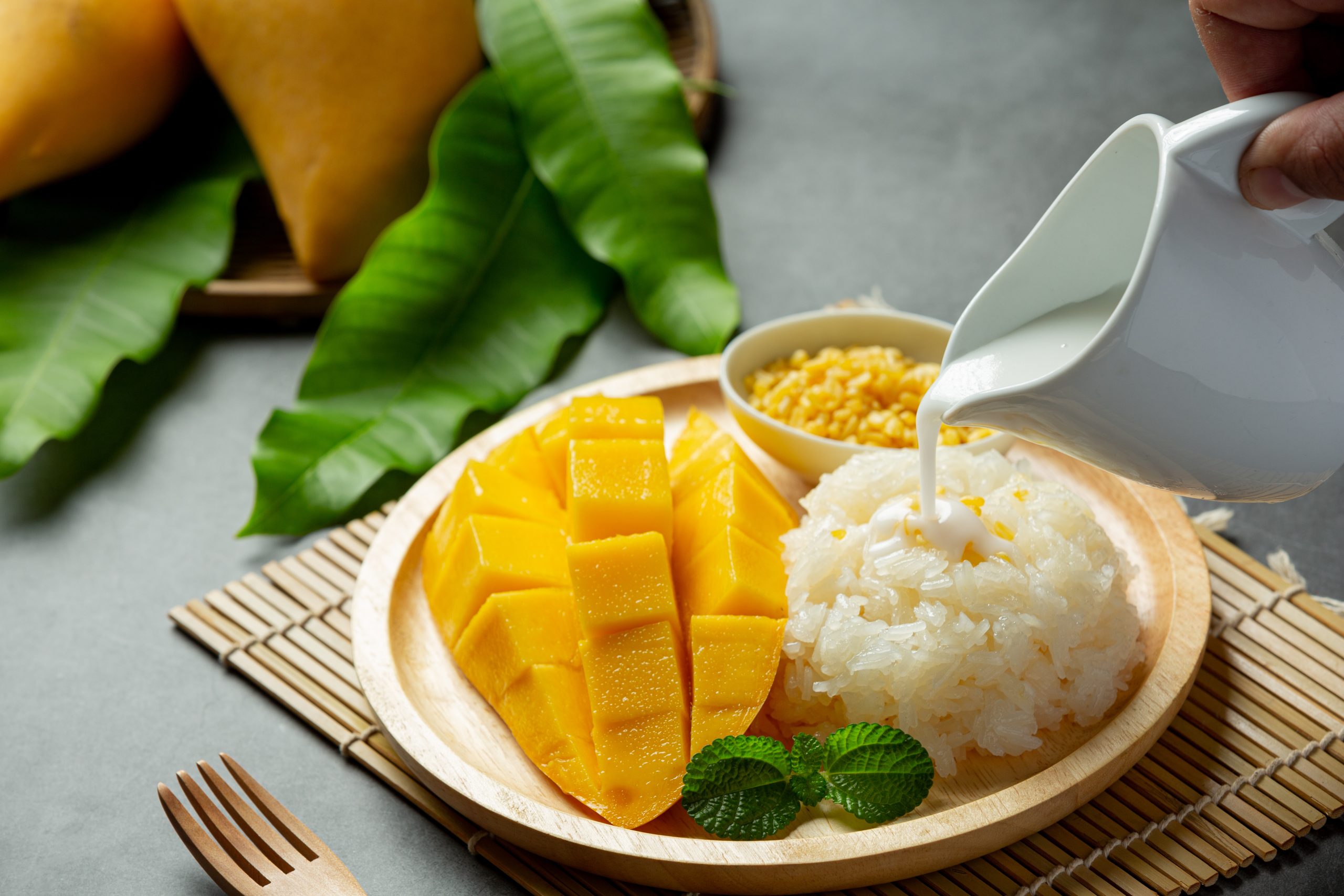
Few desserts in the world are as quietly perfect as mango sticky rice. Warm, coconut-soaked glutinous rice paired with cool slices of ripe mango and finished with a drizzle of salted coconut cream — it is a combination that feels both simple and extraordinary. A staple of Thai street food stalls and home kitchens alike, khao niao mamuang is best made when mangoes are at their ripest and sweetest. Once you've tried it made properly, no restaurant version will ever quite measure up.

Ingredients

  • 200 grams glutinous sticky rice

  • 1 can ONOFF Spices Coconut Cream

  • 3 tablespoons palm sugar (or coconut sugar as a substitute)

  • ½ teaspoon salt

  • 2 ripe mangoes, peeled and sliced

  • 1 teaspoon toasted sesame seeds or mung beans, to garnish (optional)

Directions

  • Soak the sticky rice in cold water overnight, or for a minimum of 4 hours. Drain well before cooking.
  • Line a steamer basket with muslin cloth or a clean cotton cloth, add the drained rice, and steam over boiling water for 20–25 minutes until the rice is tender, translucent, and cooked through.
  • While the rice steams, gently warm three quarters of the coconut cream in a small saucepan over low heat. Add 2 tablespoons of palm sugar and ¼ teaspoon of salt and stir until fully dissolved. Do not boil.
  • Transfer the cooked sticky rice to a bowl and pour the warm coconut mixture over it. Stir gently, then cover and leave to rest for 10 minutes so the rice absorbs the coconut cream fully.
  • For the salted coconut topping, warm the remaining coconut cream with 1 tablespoon of palm sugar and ¼ teaspoon of salt, stirring until dissolved. Set aside.
  • Arrange the sticky rice alongside the sliced mango on a serving plate. Drizzle the salted coconut topping over the rice and garnish with toasted sesame seeds or mung beans if using.
  • Serve at room temperature.

Notes

  • The mango variety matters. Look for Nam Dok Mai or Mahachanok mangoes if you can find them — they are the varieties traditionally used in Thailand and have the ideal sweetness and texture for this dish. Any ripe, sweet mango will work beautifully.